Pellet Feed vs Mash Feed: Which Is Better for Cows and Buffaloes?
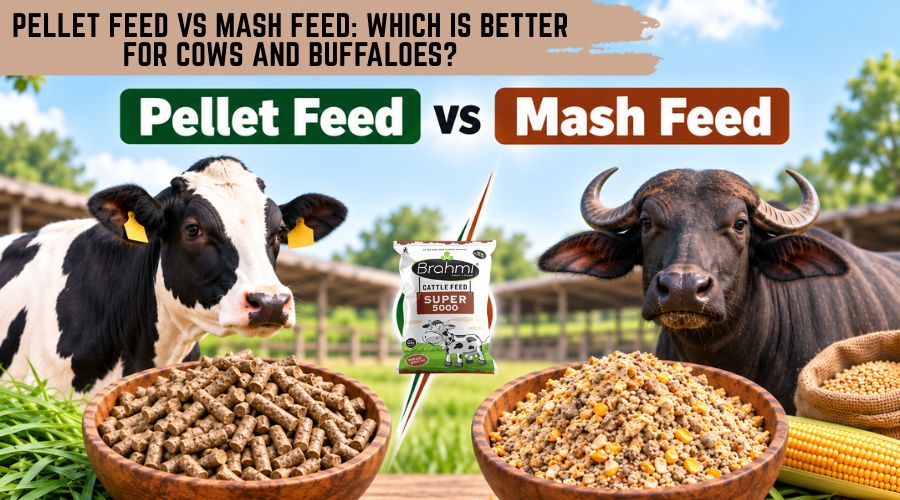
Pellet Feed vs Mash Feed is an important consideration for dairy farmers choosing suitable feed for cows and buffaloes. Pellet feed is processed and compressed into uniform pieces, while mash feed consists of finely ground and mixed feed ingredients. Both can provide essential nutrients, but their handling, storage, feeding convenience, and suitability can differ.
Choosing between cattle feed pellets and mash feed for cattle depends on the animal’s nutritional requirements, feeding system, forage availability, feed quality, and farm management practices. This guide explains the differences between pellet and mash feed, their benefits, effects on feed intake and digestion, and how farmers can select the right cow cattle feed or buffalo feed.
What Is Pellet Feed for Cows and Buffaloes?
Pellet feed is made by grinding and mixing selected feed ingredients before processing the mixture into compact, uniform pieces. Depending on the formulation, ingredients may include grains, protein sources, fiber sources, vitamins, minerals, and other nutritional components.
The pelleting process helps combine different ingredients into a consistent feed form. This makes feed pellets convenient to handle, transport, store, and distribute.
When comparing Pellet Feed vs Mash Feed, farmers should consider how each feed form fits into the animal’s complete feeding program. For dairy animals, cow feed pellet products can be formulated to complement forage and provide concentrated nutrients. Similarly, suitable pellet formulations can be used as buffalo feed according to the animal’s nutritional requirements.
Some potential practical advantages of pellet feed include:
- Uniform feed size and composition
- Easier storage and handling
- Convenient feeding and transportation
- Reduced separation of individual ingredients
- Less loose feed compared with some mash formulations
- Easy measurement and distribution
The nutritional value of pellet feed depends on the ingredients and formulation used. A pellet is not automatically better simply because it is in pellet form; feed quality and nutritional balance remain important.
What Is Mash Feed and How Is It Different?
Mash feed is a loose mixture of ground or processed feed ingredients. The ingredients are combined without being compressed into pellets.
Mash feed for cattle can contain ingredients such as grains, oil cakes, protein sources, minerals, vitamins, and other feed materials. Farmers may use mash as part of a feeding program depending on their available ingredients and feeding practices.
One of the main differences to consider when comparing Pellet Feed vs Mash Feed is their physical form. Mash feed remains loose, while pellet feed is compressed into a more compact form, making the two feed types different in texture, handling, and feeding characteristics.
Mash feed can also be practical for farms that mix their own feed or prefer loose feed. However, the uniformity of mixing and prevention of ingredient separation are important for maintaining consistent nutrient intake.
Pellet Feed vs Mash Feed: Key Differences
| Feature | Pellet Feed | Mash Feed |
| Physical form | Compact, uniform pellets | Loose, ground mixture |
| Handling | Generally easy to handle | Can be more difficult to handle |
| Storage | Compact and convenient | Requires suitable storage to prevent moisture and spoilage |
| Ingredient separation | Generally reduced | Ingredients may separate if not mixed properly |
| Feeding | Easy to measure and distribute | Can require careful mixing and distribution |
| Transportation | Convenient due to compact form | May require more space |
| Feed waste | Can help reduce loose-feed losses in some systems | May have more loose-feed losses depending on handling |
| Nutritional value | Depends on formulation | Depends on formulation |
Understanding Pellet Feed vs Mash Feed becomes easier when comparing their main characteristics.Neither form is universally better for every farm. The right choice depends on the animal, ration, feeding system, ingredient quality, and farm management.
What Are the Benefits of Pellet Feed and Mash Feed for Dairy Animals?
Both pellet and mash feeds can be useful when they are properly formulated and included in a balanced feeding program.
Benefits of Pellet Feed
Cattle feed pellets offer several practical benefits for dairy farmers.
1. Convenient Handling:Pellets are compact and easier to measure, transport, and distribute. This can make daily feeding more convenient.
2. Consistent Feed Form:Because ingredients are processed into a uniform form, pellets can help provide more consistent portions during feeding.
3. Reduced Ingredient Separation:In a properly manufactured pellet, ingredients are bound together. This can reduce the tendency of animals to selectively consume individual ingredients.
4. Easy Storage and Transportation:The compact form of feed pellets can make storage and transportation easier when appropriate storage conditions are maintained.
5. Convenient Feeding:Pellets can be easier to portion and distribute, especially on farms where consistent feeding practices are important.
Benefits of Mash Feed
Mash feed also has practical uses in dairy feeding.
1. Flexible Mixing:Farmers can combine different ingredients into a loose feed mixture according to the feeding program.
2. Easy Ingredient Adjustment:Mash formulations can be adjusted when farmers have suitable ingredients and appropriate knowledge of feed formulation.
3. Practical for Certain Feeding Systems:Some farms may prefer mash because of existing equipment, feeding routines, or local ingredient availability.
4. Suitable When Properly Formulated:A well-mixed mash can provide essential nutrients when its ingredients are selected and combined according to the nutritional requirements of the animals.
The important point is that both forms should provide appropriate nutrition. The physical form alone does not determine feed quality.
Pellet Feed vs Mash Feed: Which Is Better for Milk Production?
When comparing Pellet Feed vs Mash Feed for milk production, there is no universal answer that applies to every cow or buffalo.Milk production depends on the animal’s genetics, stage of lactation, health, body condition, forage quality, energy intake, protein supply, water availability, and overall management.
When considering Pellet Feed vs Mash Feed, a properly formulated pellet feed can provide concentrated nutrients and help make feeding more consistent. Similarly, properly formulated mash feed can provide suitable nutrition when its ingredients are mixed correctly and the animal receives adequate forage and clean water.
For farmers looking for the best feed for cows to increase milk, the focus should be on the complete nutritional program rather than simply choosing pellets over mash.The same principle applies when selecting the best feed for buffalo. A balanced ration that meets the animal’s nutritional requirements is more important than feed form alone.
How Do Pellet and Mash Feeds Affect Feed Intake and Digestion?
When comparing Pellet Feed vs Mash Feed, feed form can influence how animals handle and consume feed, but digestion ultimately depends on the complete diet and the animal’s nutritional needs. Pellets combine several ingredients into a compact form, which can reduce ingredient selection and make it easier to provide a consistent mixture of nutrients.
The mash remains loose, so proper mixing is important. If ingredients are not mixed adequately or become separated during handling, animals may consume different proportions of ingredients.
For dairy animals, fiber is particularly important for maintaining normal rumen function. When considering Pellet Feed vs Mash Feed, farmers should ensure that the overall ration contains suitable forage and adequate fiber, regardless of the feed form they choose. Good-quality dairy cattle feed should therefore be evaluated based on its complete nutritional profile, ingredient quality, digestibility, and suitability for the animal.
Clean drinking water should also be available at all times because water is essential for normal digestion, body functions, and milk production.
How to Select the Right Feed for Cows and Buffaloes
Farmers should consider several factors when choosing between pellet and mash feed.
Consider the Animal’s Nutritional Needs
When comparing Pellet Feed vs Mash Feed, farmers should remember that feed requirements vary according to the cattle’s age, milk yield, stage of lactation, body condition, and overall health.
Check the Feed Formulation
Look at the nutritional profile rather than choosing feed based only on its appearance. Protein, energy, fiber, minerals, vitamins, and other nutrients should be considered.
Evaluate Ingredient Quality
Quality ingredients contribute to consistent nutritional value. Ingredients such as corn for cattle feed can provide energy, while suitable protein sources can contribute essential nutrients.
Similarly, corn feed for cows may be used as part of an appropriately balanced ration.
Consider Forage Availability
Pellet or mash feed should complement available forage. Farmers should consider the quantity and quality of green fodder, dry fodder, silage, and other roughage sources.
Check Manufacturing Quality
When purchasing commercial feed, farmers should consider reliable cattle feed suppliers and manufacturers that follow appropriate quality-control practices.
Consider Storage and Handling
The feed should be stored in a dry, clean, well-ventilated area and protected from moisture, pests, and contamination.
Choose According to Farm Management
The best feeding option is one that provides suitable nutrition while fitting the farm’s handling, storage, feeding, and management practices.
Brahmi Cattle Feed – Quality Pellet Nutrition for Dairy Animals
Brahmi Cattle Feed focuses on providing quality feed solutions designed to support the nutritional requirements of dairy animals. Its range of cattle feed products is developed with attention to nutritional balance, ingredient quality, and practical feeding needs.
For farmers comparing Pellet Feed vs Mash Feed, the focus should remain on the nutritional value and suitability of the complete feed. Pellet feed can offer practical benefits such as convenient handling, consistent feed form, and easier distribution.Brahmi Cattle Feed provides pellet-based feed solutions that can complement forage and other components of a properly managed dairy feeding program.
What Makes Brahmi Cattle Feed a Reliable Choice?
Choosing a reliable cow cattle feed or buffalo feed involves looking at more than just feed form. Ingredient quality, nutritional balance, consistency, manufacturing practices, and suitability for the animal are all important.
Brahmi Cattle Feed focuses on balanced nutrition, quality ingredients, consistent manufacturing, and farmer convenience. Its pellet feed provides essential nutrients while offering easy handling, storage, transportation, and portioning.
Quality checks help maintain consistency, and the products are designed to complement the nutritional needs of dairy animals. Farmers should choose feed based on their animals’ nutritional requirements and complete feeding program.
Why Choose Brahmi Cattle Feed for Better Cow and Buffalo Nutrition?
Brahmi Cattle Feed provides quality pellet-based feed solutions designed to complement forage and other feed sources in a balanced dairy feeding program. Its focus on nutritional value, quality ingredients, and consistent feed production makes it a practical choice for farmers managing cows and buffaloes.
Proper nutrition is important for maintaining healthy body condition, digestion, immunity, and productive performance. A complete feeding program should provide the right balance of protein, energy, fiber, vitamins, minerals, and clean water according to the animal’s individual needs.
Key benefits of choosing Brahmi Cattle Feed include:
- Balanced Nutrition: Supports the nutritional needs of dairy animals.
- Quality Ingredients: Carefully selected ingredients help maintain feed quality and consistency.
- Pellet Form: Makes handling, storage, transportation, and portioning more convenient.
- Consistent Quality: Manufacturing and quality checks help maintain reliable feed products.
- Dairy-Focused Solutions: Designed to complement the feeding needs of cows and buffaloes.
- Farmer Convenience: Easy-to-manage pellets can simplify everyday feeding practices.
Whether farmers are looking for the best feed for buffalo or suitable organic cattle feed options, it is important to consider the complete nutritional profile of the feed. Brahmi Cattle Feed can be included as part of a well-planned ration based on the animal’s nutritional requirements.
Farmers should select feed according to the animal’s age, body condition, milk production stage, forage availability, and overall feeding program. With proper nutrition and management, quality cattle feed products can support healthier dairy animals and consistent farm performance.
Choose Brahmi Cattle Feed for Quality Pellet Feed
If you are comparing Pellet Feed vs Mash Feed, consider nutrition, ingredient quality, feed consistency, storage, handling, and the specific needs of your cows and buffaloes.Brahmi Cattle Feed offers quality pellet feed solutions designed to complement forage and support balanced dairy nutrition. Its pellet format can provide farmers with a convenient option for daily feeding and feed management.
For farmers searching for reliable cattle feed suppliers, choosing a quality-focused manufacturer can help support consistent feeding practices and better livestock nutrition.
Contact Information
Brahmi Cattle Feed
Address: Village Nanhera, Tehsil Rajpura, Punjab, India – 140147
Call: 9592046590
Email: brahmioffice@gmail.com
Conclusion
The choice between Pellet Feed vs Mash Feed depends on the animal’s nutritional requirements, available forage, feeding system, farm management, and overall feed quality. Pellet feed offers practical benefits such as convenient handling, compact storage, consistent feed form, and reduced ingredient separation, while mash feed provides flexibility for farms that prefer loose feed mixtures.
Neither feed form is automatically best for every cow or buffalo. Farmers should focus on a balanced feeding program that provides suitable protein, energy, fiber, vitamins, minerals, forage, and clean water. Choosing quality cattle feed products from reliable cattle feed suppliers and following proper feeding practices can support healthy dairy animals and consistent productive performance.
FAQs – Pellet Feed vs Mash Feed: Which Is Better for Cows and Buffaloes?
Q1. What is the difference between mash feed and pellet feed?
Ans. Mash feed is a loose mixture of ground feed ingredients, while pellet feed is processed and compressed into compact, uniform pieces. Both can provide suitable nutrition when properly formulated.
Q2. What is the healthiest feed for cattle?
Ans. The healthiest feed is one that provides balanced nutrition according to the animal’s age, body condition, production level, and other nutritional requirements. Good-quality forage, suitable concentrate feed, minerals, vitamins, and clean water should form part of an appropriate feeding program.
Q3. Are pellets good for cows?
Ans. Yes, properly formulated pellet feed can be a convenient source of nutrients for cows. Its suitability depends on the nutritional formulation and how it fits into the cow’s complete diet.
Q4. At what age should a calf be given pellets?
Ans. Calves can be introduced to suitable calf starter pellets at an early age alongside milk or milk replacer, according to their development and feeding program. The timing and amount should be adjusted based on the calf’s health, intake, and nutritional needs.
Q5. What nutrient makes cattle grow the fastest?
Ans. There is no single nutrient that makes cattle grow the fastest. Growth requires a balanced supply of energy, protein, minerals, vitamins, fiber, and adequate water, along with good health and management.