Best Calf Feed for Healthy Growth: Nutrition Guide for Dairy Farmers
Calf Feed plays an important role in supporting the healthy growth and development of young calves. A well-formulated feed can provide essential protein, energy, fiber, vitamins, and minerals that complement milk, forage, and clean water during the early stages of life. The right Calf Feed can support healthy body development, rumen development, body condition, and prepare calves for their future role in the dairy herd.
Choosing quality feed depends on the calf’s age, growth stage, breed, body condition, forage availability, and overall feeding program. Whether farmers raise dairy cows, dairy cattle, domestic cattle, or smaller breeds such as a mini cow, miniature cow, or mini cattle, nutrition should be adjusted according to the animal’s actual requirements. This guide explains what good Calf Feed should contain, when calves should start eating it, how much they may need, and how farmers can choose suitable feed products.
Why Is Proper Calf Nutrition Important?
Proper nutrition during the calf stage lays the foundation for healthy growth and future dairy performance by providing essential nutrients for muscle and skeletal development, immune function, rumen development, and normal body maintenance. In the early stage, calves depend mainly on milk or milk replacer, but as they begin consuming solid feed, introducing suitable Calf Feed can support solid-feed intake and help them gradually adapt to a more mature feeding pattern.
Good nutrition, along with clean water, proper housing, and appropriate health care, can support healthy calf development and future herd performance. For dairy farmers, providing suitable nutrition during this important growth stage is an essential part of long-term herd management and cow milk production planning.
What Should Good Calf Feed Contain?
Good Calf Feed should be formulated to provide a balanced combination of nutrients rather than relying on a single ingredient. The exact calf feed formulation depends on the calf’s age, growth stage, feed intake, and nutritional requirements.
A quality feed may provide:
- Protein for muscle and tissue development
- Energy for growth, activity, and body maintenance
- Fiber to complement rumen development and digestive function
- Vitamins and minerals for normal growth and body functions
- Suitable ingredients for palatability and consistent feed quality
Farmers should also consider the complete ration. Calf feed is only one part of a feeding program that may include milk or milk replacer, forage, water, and a suitable calf feed supplement when required.
Protein, Energy, Fiber, Vitamins and Minerals for Calves
- Protein
Protein is essential for muscle development, tissue formation, growth, and normal body maintenance. Growing calves require an appropriate protein supply according to their age and growth stage.
A good Calf Feed may include protein-rich ingredients selected to provide the desired nutritional profile. The overall quality of the protein source matters along with the total protein content of the ration.
- Energy
Calves require energy for growth, physical activity, body maintenance, and development. Grains and other energy-rich ingredients may be included in formulated feed to help meet these requirements.
Energy should be balanced with protein and other nutrients rather than increased on its own.
- Fiber
Fiber becomes increasingly important as calves consume more solid feed and their rumen develops. Suitable forage can complement concentrate feed and contribute to normal digestive function.
A feeding program should therefore combine the right amount of concentrate feed with appropriate forage rather than relying entirely on concentrated feed.
- Vitamins and Minerals
Vitamins and minerals support normal bone development, immunity, metabolism, and other body functions. Depending on the calf’s ration, these nutrients may be included directly in the feed or supplied through a suitable calf feed supplement.
The required amounts depend on the animal and the overall diet, so farmers should follow product recommendations and appropriate feeding guidance.
Best Feed Ingredients for Healthy Calf Growth
The best Calf Feed is generally based on a carefully balanced formulation using suitable ingredients rather than one single raw material. Common ingredients may include grains, protein sources, fiber sources, vitamins, minerals, and other feed materials selected according to the nutritional objective.
- Grains and Energy Sources
Grains can contribute energy to calf diets. Their inclusion and processing should be appropriate for the calf’s growth stage and the overall formulation.
- Protein Sources
Protein ingredients can help meet the growing calf’s protein requirements. The appropriate source and inclusion level depend on the complete calf feed formula.
- Fiber Sources
Suitable fiber sources and forage help complement concentrate feed and support the calf’s transition toward a more mature digestive system.
- Vitamins and Minerals
These are often included in formulated cattle feed products to help support nutritional balance.
- Feed Quality and Processing
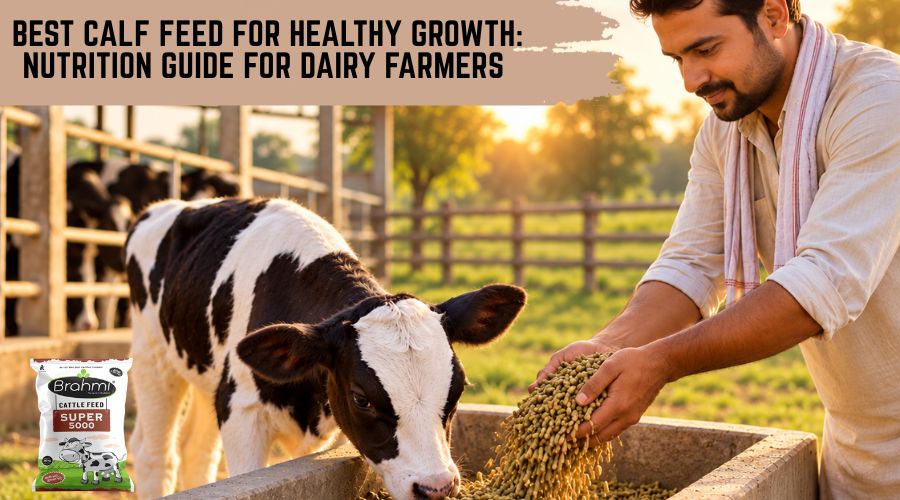
Ingredient quality is important, but so are manufacturing, storage, handling, and feed consistency. Cattle feed pellets can provide a uniform feed form that may make storage, transportation, and daily portioning more convenient for farmers.
When Should Calves Start Eating Calf Feed?
Calves can begin being introduced to small amounts of starter feed at an early age, often within the first few weeks of life, while milk or milk replacer remains an important part of the early feeding program.
The exact timing of introducing Calf Feed depends on the calf’s intake, development, health, and farm management system. Calves should be given access to suitable starter feed and clean water while their solid-feed intake gradually increases.
As the calf consistently consumes solid feed and progresses through the weaning stage, the feeding program can gradually transition toward Calf Grower Feed. There is no single age that applies to every calf, so farmers should monitor intake and development rather than using age alone.
A product such as calf starter premium may be used during the early solid-feed stage, followed by a suitable grower feed as the calf develops.
How Much Calf Feed Should a Calf Eat?
The amount of Calf Feed a calf needs depends on its age, body weight, breed, growth rate, health, forage intake, and the nutritional density of the feed.
Rather than following one fixed quantity for every animal, farmers should consider:
- Calf age and body weight
- Daily solid-feed intake
- Milk or milk replacer intake
- Forage quality and quantity
- Growth and body condition
- Feed formulation and nutrient density
- Overall health and management
Feed should generally be introduced gradually, especially when changing from one product to another. Farmers should monitor appetite, manure consistency, body condition, and growth to determine whether the feeding program is appropriate.
The manufacturer’s feeding instructions should be followed for packaged cattle feed products, with adjustments made according to the complete ration and professional nutritional guidance where needed.
Common Feeding Practices That Affect Calf Growth
Even a good Calf Feed may not provide the expected results if feeding practices are inconsistent. Farmers should pay attention to the complete management program.
- Sudden Feed Changes
Abrupt changes can affect feed intake and digestion. New feed should generally be introduced gradually.
- Poor Water Availability
Clean, fresh water should be available regularly. Water is important for digestion and normal body functions and becomes increasingly important as calves consume more dry feed.
- Too Much Concentrate and Too Little Forage
Concentrate feed should complement suitable forage. A balanced feeding program should provide both according to the calf’s growth stage.
- Inconsistent Feeding
Irregular feeding schedules and inconsistent quantities can make it harder to maintain a stable nutritional program. Following a routine can make daily calf management easier.
- Poor Feed Storage
Moisture, contamination, pests, and poor storage conditions can reduce feed quality. Feed should be kept in a clean, dry, protected area.
- Choosing Feed Only by Price
Price is one factor, but farmers should also compare nutritional value, ingredients, feed quality, consistency, and suitability for the animal. A reliable cattle feed company should provide clear product and feeding information.
About Brahmi Cattle Feed – Complete Nutrition for Growing Calves
Brahmi Cattle Feed provides practical feed solutions for dairy farmers, focusing on quality nutrition, selected ingredients, consistent manufacturing, and convenient feed formats. Calf nutrition should be part of a complete program that includes suitable milk or milk replacer, forage, clean water, proper housing, and routine health care. For farmers choosing cattle feed products for growing animals, feed should be selected according to the calf’s age, growth stage, and nutritional requirements.
Brahmi’s pellet-based feed solutions can offer practical benefits in handling, storage, transportation, and portioning on dairy farms. Whether raising domestic cattle, a small cow, mini cow, or miniature cow, farmers should follow the same basic principle: choose feed according to the animal’s specific nutritional needs and growth stage.
Why Choose Brahmi Cattle Feed to Support Better Calf Development?
Brahmi Cattle Feed focuses on practical nutrition for dairy animals, with attention to feed quality, ingredient selection, consistency, and farmer convenience.
Key considerations include:
- Balanced Nutrition: Feed products are formulated to provide important nutrients needed by growing dairy animals and can complement the rest of the calf ration.
- Quality Ingredients: Selected ingredients contribute to the nutritional value, palatability, and consistency of the feed.
- Pellet Form: Uniform pellets can simplify handling, storage, transportation, measurement, and daily portioning.
- Consistent Quality: Controlled manufacturing and quality checks help support consistency between feed batches.
- Dairy-Focused Solutions: Feed products are designed to complement the nutritional requirements of dairy animals at different growth stages.
- Farmer Convenience: Practical feed formats can make everyday feeding and feed management easier on dairy farms.
Farmers should choose Calf Feed according to the calf’s age, body condition, growth stage, forage availability, and complete feeding program. The right feed is one that fits the animal’s nutritional requirements and works well with the rest of the ration.
Get Quality Calf Feed Solutions for Healthy Growth
Choosing the right calf feed helps support healthy growth and development. Farmers should consider the calf’s age, growth stage, nutritional requirements, and complete feeding program. Brahmi Cattle Feed offers feed solutions designed to complement proper calf nutrition and management. Choose a suitable product based on your calf’s specific nutritional needs.
Explore Brahmi Cattle Feed products for quality calf nutrition and growth support.
Address: Village Nanhera, Tehsil Rajpura, Punjab, India – 140147
Call: 9592046590
Email: brahmioffice@gmail.com
Conclusion
Choosing the best Calf Feed starts with understanding the calf’s nutritional needs. Protein, energy, fiber, vitamins, minerals, clean water, and suitable forage all play an important role in healthy growth and development. Farmers should also consider ingredient quality, feed formulation, feed form, manufacturing consistency, storage, and feeding practices when selecting a product.
A reliable cattle feed company can provide suitable feed products, but the final choice should always match the calf’s age, growth stage, and complete feeding program. With balanced nutrition, proper management, and regular monitoring, farmers can support healthy calf development and build a stronger foundation for the future dairy herd.
FAQs – Best Calf Feed for Healthy Growth: Nutrition Guide for Dairy Farmers
Q1. What is the best calf feed for healthy growth?
Ans. The best Calf Feed is one that provides suitable protein, energy, fiber, vitamins, and minerals according to the calf’s age and growth stage. It should complement milk or milk replacer, forage, clean water, and the rest of the feeding program.
Q2. What nutrients should calf feed provide for proper growth and development?
Ans. Quality Calf Feed should provide appropriate protein, energy, fiber, vitamins, and minerals. The exact nutritional requirements depend on the calf’s age, body weight, breed, growth rate, and overall diet.
Q3. When should calves start eating calf feed?
Ans. Calves can usually be introduced to suitable starter feed during the first few weeks of life while milk or milk replacer remains important. As solid-feed intake increases and the calf progresses through weaning, the program can gradually transition to Calf Grower Feed.
Q4. How much calf feed should a growing calf receive each day?
Ans. The amount varies according to the calf’s age, body weight, growth stage, feed formulation, forage intake, and overall ration. Farmers should follow the product’s feeding recommendations and adjust the quantity based on the calf’s development and nutritional needs.
Q5. How can dairy farmers choose quality calf feed for healthy development?
Ans. Farmers should check the nutritional profile, ingredient quality, manufacturing standards, feed consistency, storage requirements, and suitability for the calf’s growth stage. Choosing reliable cattle feed products and following proper feeding practices can support healthy calf development.